From Virginia, our last post, we continued to move south into North Carolina where we spent a few days and finally got our bicycles out for long past due ride. This trail was another "rails to trails" and was about 17 miles long. (We didn't do all 17 miles--just 7.) A very flat but beautiful ride thru the woods.
After the ride we spent a relaxing evening with Jackie's nephew Brad Cook and his fiance Melissa who prepared a delicious dinner. We reciprocated and had them over to our humble home the next evening for dinner and very enjoyable evening. (The bike trail goes less than a mile from their home.)
What better stop than the next state south of here into South Carolina. We found a camp site on a very large lake just behind us. Not many people around and several miles away from the freeway so quite pretty.
The morning broke with a light fog over the lake just behind us, but that evening was another example of the changes that mother nature shares with us.
We only spent two nights here, but with sights like this it was hard to pack up and move again.
Last state before we made it to Florida was Georgia where we spent a few days seeing some of the sights, one being Fort Frederica National Monument. Georgia's fate was decided in 1742 when Spanish and British forces clashed on St. Simons Island. Fort Frederica's troops defeated the Spanish, ensuring Georgia's future as a British colony.
The remains here are mostly the refurbishd foundations,
If interested you can get more history of this National Monument. Check it out here.
This area of Georgia was full of live oaks with spanish moss drifting back and forth in the light breeze.
Not far from the National Monument was St. Simons Island Lighthouse sitting in the middle of town built in1872 and stands 104' tall.
We made it up the 129-steps to get a picture of Jackie looking over the Atlantic Ocean
Well, we finally made it to Florida where we are greeted by a half dozen or so Sand Hill Cranes wandering around the park. You could feed them out of your hand.
Check out the eye of this guy (gal?) watching to see what Dick was doing with the camera.
And finally this guy was sharing our site living in a hole he dug next to the sewer hookup.
We have our schedule all set until about the 3rd of March when we plan on heading back north and then west. Remember, it's all subjet to change. If interested in our schedule just click here.
To be continued...
Tuesday, December 13, 2011
Monday, November 14, 2011
Jamestown and Colonial Williamsburg Virginia
The plan was to tell and show you with our pictures where 104 men and boys landed at Jamestown Virginia May 13 1607 and set up the first settlement that was later to be part of the United States of America. By 1609 there was close to 300 colonists in Jamestown. Then the winter of 1609-1610 came and when it was over, only 60 survivors remained, most dieing from starvation. The town was slow to grow on it's own until 1620 when 90 unmarried women arrived.
The town finally started to grow and prosper once they found out what a wonderful cash crop there was in tobacco, sending it back to England for a very good profit. The original settlement went into disrepair and finally found it's way back to nature. Several people in the last century tried to locate the original site but all decided that the river had taken it all, until 1994 when there was one last try in trying to locate it. A post hole was located and next to it was another and then another. Continuing to follow the trail of post holes, the outer perimeter of the original Jamestown fort was located. From there it was pretty easy to start excavation to locate all the treasurers that lay beneath the soil.
When Dick went to look over the pictures, to his dismay they were not there, lost to the delete key on the computer we think, so we won't be telling you about Jamestown in pictures, but will go to another period of history in our great Nation where we spent two days,
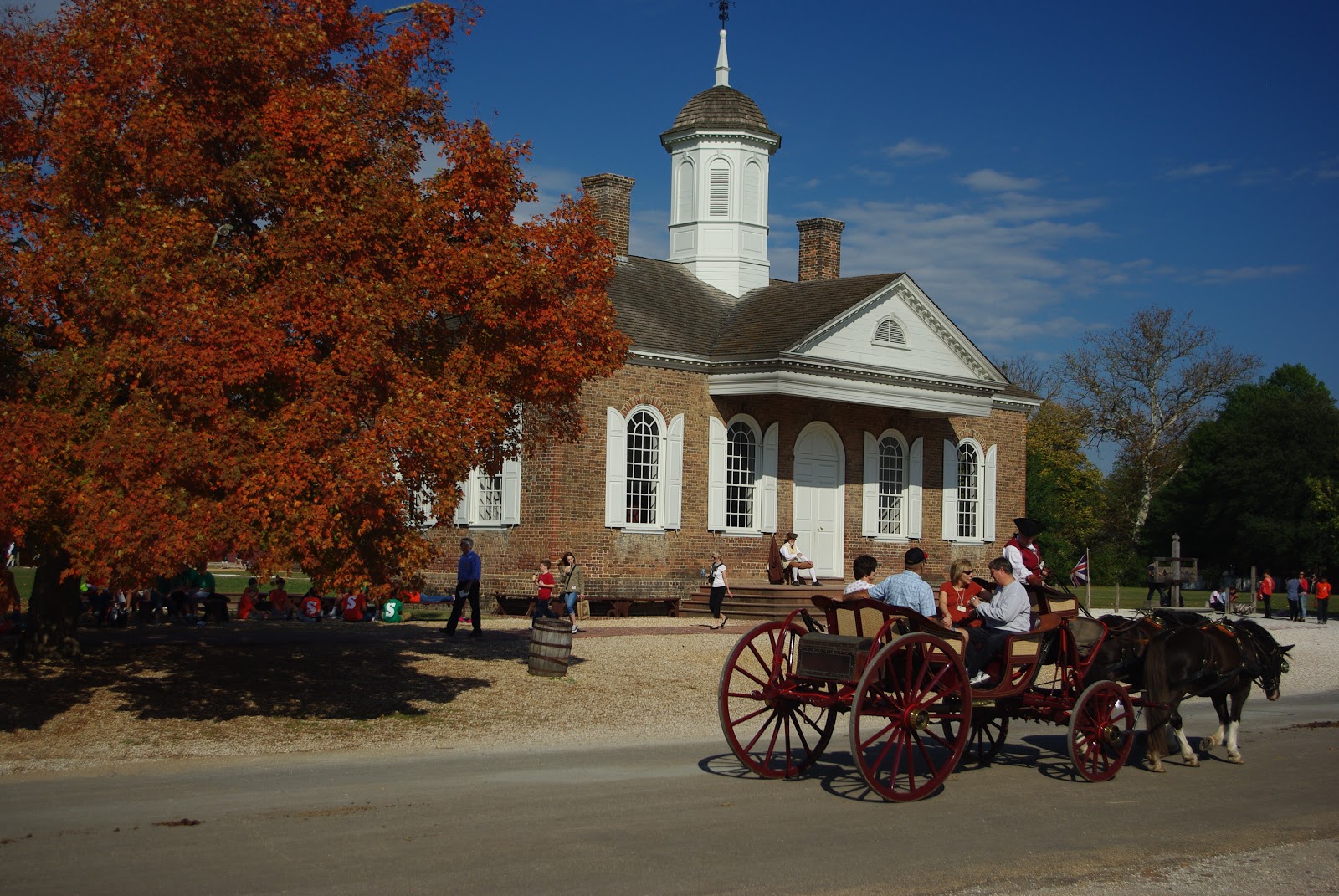
Colonial Williamsburg Virgina consists of over 300 acres of the town of Williamsburg that has either survived or been rebuilt to the late 18th century or at the time of the start of our desires to become an independent nation. It was time to cut our ties with England and the war that lasted over 7 years came about because the men here drafted and signed a document called 'The Declaration of Independence'.
The capitol building at the end of Duke of Gloucester Street has been rebuilt several times through the years.
From the web:
The first colony to speak for American independence, Virginia spoke with the unanimous voices of the gentlemen who gathered May 15, 1776, in the tall brick building that dominated the east end of Williamsburg. From what had been England's original New World possession, Virginia instructed its delegation at Philadelphia's Continental Congress to move the question of freedom. Thomas Jefferson's Declaration of Independence records the Continental Congress's answer.
The gentlemen at Williamsburg sat in the oldest representative assembly in what was now the world's newest nation. The legislature first met at Williamsburg on April 21, 1704, when the Capitol on Duke of Gloucester Street was still under construction. Literally and figuratively, however, its foundation dated to 1619, when the House of Burgesses first convened at Jamestown.
A little closer look
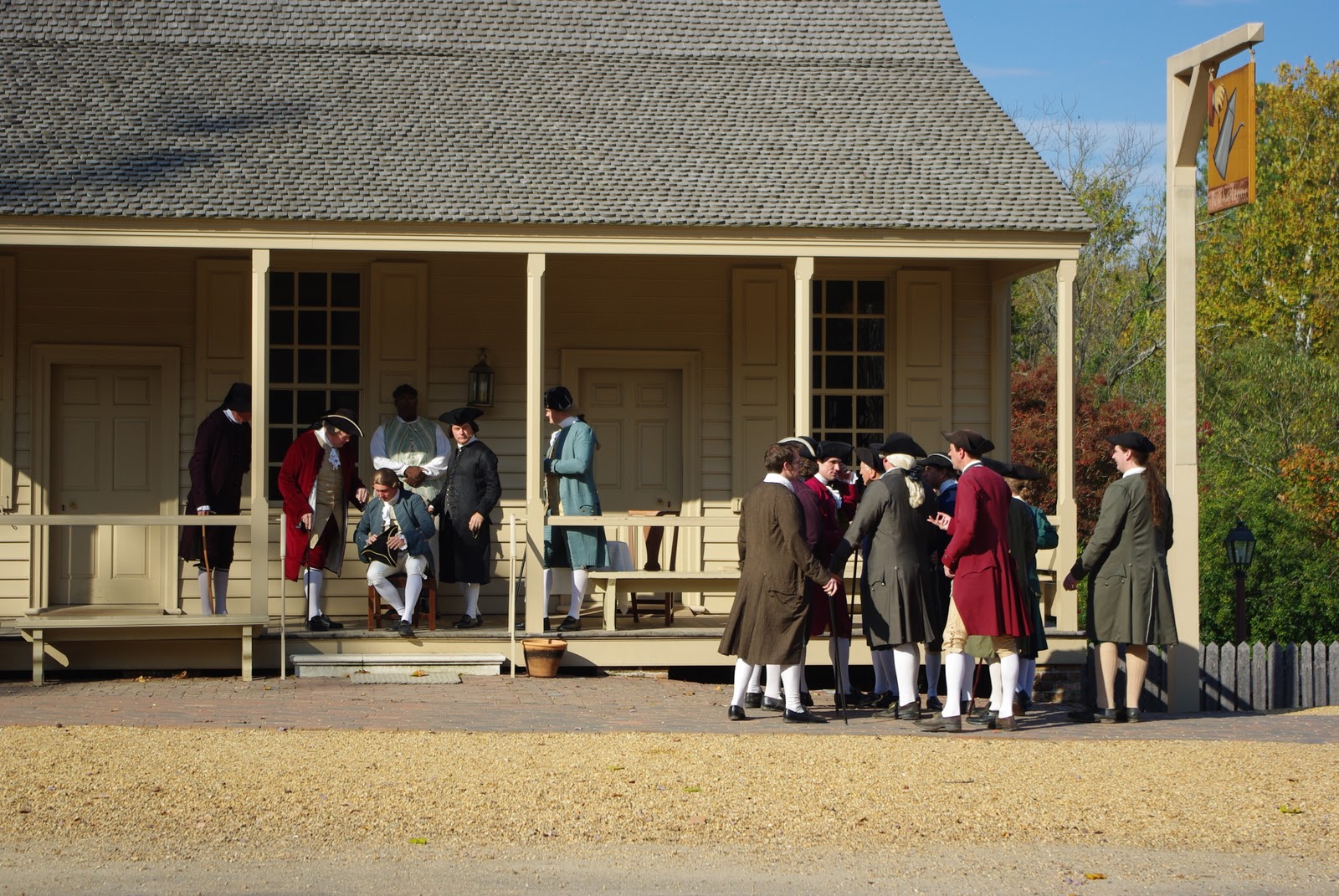
Walking the main street of Williamsburg one can see people in period dress who will reenact scenes from our history.
Shop keepers showing off their trades. Weaver...
If you get tired of walking just hitch a ride on a carriage.
Here is a scene in front of the baker's building, depicting people of the time of the revolution talking about what was happening. We loved the feeling of being right there!
Bassett Hall built around 1760 but displayed today as it was furnished by the John D Rockefeller Jr. family in the 1940's
Exterior view, looks pretty good for being built 250 years ago.
To be continued...
Wednesday, November 2, 2011
Connecticut and Pennsylvania
Off to CT to visit more friends in Milford; thanks Barb and Dave for your hospitality. No RV parks in the area so we just parked in the local Walmart parking lot off in a corner for 3 days and spent some wonderful time with them. One day they took us on a day trip to the campus of Yale University and while there we visited Beinecke Rare Book Library housed inside a building made of thin marble so the light actually penetrated it. Inside was a glass encased room housing all the rare books. Quite an interesting design. The public is not allowed inside the glass but you can have the books brought out to you for research. If you are interested in more details about this library go to
beinecke.library @yale.edu.
Outside Dick had to set the pose as "the thinker", really lame, but that's Dick.
Now this is a lot better with the two of us.
We had a long day touring Yale and stopping for pizza in town. On another day they took us to Weir Farm National Historic Site. Weir Farm National Historic Site was home to three generations of American artists. Julian Alden Weir, a leading figure in American art and the development of American Impressionism, acquired the farm in 1882. After Weir, the artistic legacy was continued by his daughter, painter Dorothy Weir Young and her husband, sculptor Mahonri Young, followed by New England painters Sperry and Doris Andrews. Today, the 60-acre farm, which includes the Weir House, Weir and Young Studios, barns, gardens, and Weir Pond, is one of the nation’s finest remaining landscapes of American art.
The house is currently being brought back to what it was when the Weirs lived there.
Departed CT and off to PA where our first stop had to be Ephrata, PA. Being we are from Ephrata, WA, we just had to see this town. Quite a bit larger than our Ephrata. We still wore our Ephrata Tigers tee shirts and people stopped us and informed us that Ephrata was not the Tigers. Most were interested to hear that there is another Ephrata, even though we pronounce it differently.
Looking down through town. A really pretty small town with very friendly folks.
Then it was off to visit the Hershey Chocolate Company. We took a tour of a mockup factory and then the store with all the chocolate one could want. But we were good -- we only bought postcards and one small candybar to share.
Looking down on just a small part of the store.
We also had to check out some of the covered bridges in the area. Of course we did this in the jeep, not taking the Motorhome through.
And one last view of the fall colors.
To be continued...
Monday, October 17, 2011
Fall colors in Maine
Every place we have been in the last year or so we have been told that it's hotter than usual or wetter or drier than every year. When we finally got to Maine to see the fall colors the message we received was that you should have been here last year to see the great foliage colors.
We did a lot of looking and here are a series of some of the pictures we got of the colors of New England, so just enjoy some of what we saw.
No color here, just the sun shining on the a small bay in Maine.
To be continued...
We did a lot of looking and here are a series of some of the pictures we got of the colors of New England, so just enjoy some of what we saw.
No color here, just the sun shining on the a small bay in Maine.
To be continued...
Tuesday, October 11, 2011
1000 Islands and Singer Castle
Our goal when we left western Washington was the little town of Medway Maine, and it took us 56 days, 3,984 miles and we stopped at 26 locations. Had the pleasure of visiting friends and family as we traveled across our great Country.
But before we share some of Maine's fall colors we need to finish up a few places we visited before we arrived here. So lets go back to up-state New York where we hiked into salmon falls and wished that it was about 2 weeks later so the leaves could have had more time to turn. But you get what we saw.
Only 120' of falling water but sure was a great place to visit. We hiked to the top of the falls and got some pictures shooting down from the side of the hill. CC got to go with us on this one, and seemed to have a good time.
Another day we drove to Alexandra Bay and took a tour boat for a 3 hour trip to tour the Singer Castle. It turned out to be a foggy day so it was hard to get some good clear shots. This is the 1000 Island part of New York and we sailed by lots of islands, both small and large. This one looked like a battleship to us.
This was 3 islands that they put in a walkway between them to form one complete island with a lighthouse. One of the islands we saw was so small that the small house (not pictured) that was built on it cantilevered over the water on two sides. When you own an island we guess you can do with it what you want.
But the surprise an hour out was our destination, the Singer Castle. A part of American history and local folklore meet at Singer Castle on Dark Island, located on the St. Lawrence Seaway. Singer Castle is the only castle on the river to be completed, fully furnished and resided in during the heyday of the 'great builders' and industrialists in New York. The Castle remained in the possession of the original Bourne family from its construction in 1905 until the mid 1960's. The castle was built as a hunting lodge by the 5th President of Singer Sewing Machine Co. It is not currently occupied, but one can rent the guest suite for $700/night which includes a catered dinner and breakfast. Any takers?
This castle was on another island. We could have got off the boat and toured this one (self-guided), but opted not to. (next time) It is currently being completed. (Construction ended in the 1930's when the owner's wife died unexpectedly.)
Although it was a foggy day, we thoroughly enjoyed the boat trip and the history lessons.
On the way back to our home (motor home) we had to turn around after driving by this so Dick could stop and take this picture to share. We like to close our blog with something a little fun so hope you enjoy this shot.
To be continued...
Subscribe to:
Posts (Atom)